



The Mirage of Digitalization
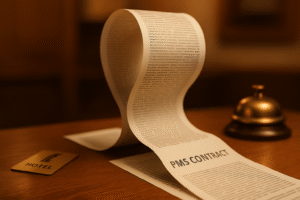
In the pursuit of modernizing their operations, many hotels embrace digitalization as a leap toward efficiency. Moving to the cloud, automating processes, and centralizing reservations sound like progress. But behind this technological mirage, part of the industry ends up trapped in rigid, long-term contracts that are costly to break.
The paradox is that the dream of digital flexibility often turns into the opposite: years of mandatory commitment, clauses that are hard to interpret, and automatic renewals that leave little room to change direction. The result is a silent dependency that contradicts the very spirit of digital transformation.
And while software providers bear responsibility for imposing these terms, the problem doesn’t start or end there. There’s also a hotel culture that signs without reading, doesn’t seek advice, and accepts without comparison. This contractual inertia means that instead of moving toward innovation, many hotels end up giving up their freedom to choose.
The Mechanics of “Lock-In”
In hospitality, contractual lock-in is built through simple clauses that, combined, reduce freedom of exit:
- Minimum terms: contracts of 12, 24, or 36 months. This model is common in SaaS across industries, where the initial period sets the mandatory commitment. Afterward, the agreement automatically renews unless notice is given.
- Automatic “evergreen” renewals: the contract renews itself year after year unless the hotel gives notice within a specific period. In contract law, this is known as an evergreen clause. California BPC, Art. 9: ARL
- Advance notice: a window of 30 to 90 days to communicate non-renewal. Missing the window means being locked in for another full period.
- Early termination penalties: fines, fees, or forfeiture of already-paid amounts that discourage ending the contract early. FTC Guide on “Negative Option”
Real Examples in PMS
- Amadeus Hospitality: automatic renewal after the initial term and 90-day written notice required to avoid renewal. TravelClick Terms · MSA PDF
- Mews: the initial subscription automatically renews every year unless canceled within the required timeframe. Master Terms · Master Terms (PDF)
- hotelkit: a 12-month minimum from acceptance and termination allowed with 10 business days’ written notice before the end of the contract year. General Terms · Official FAQ
More Flexible Counterexamples
- Cloudbeds: allows subscription cancellation directly from the billing portal. The cancellation process and form are clearly detailed. How to Cancel My Subscription
- MiniHotel: operates as a SaaS focused on flexibility and transparency; hotels can consult the current terms for cancellation and subscription conditions. Terms and Conditions · FAQ
Consequences for Hotels
Contractual lock-in doesn’t just affect finances. It shapes how hotels relate to technology and to their own business.
Limiting Technological Freedom
Switching PMS systems stops being a strategic decision and becomes a financial burden. Long-term contracts often mean that if a hotel wants to migrate, it must pay for two systems in parallel: the old one that can’t yet be canceled, and the new one starting to operate. That double expense discourages innovation and reinforces dependency.
Stifling Innovation
Many hotels stop exploring new tools out of fear of penalties or administrative friction. Instead of experimenting, they settle. Technology that should empower operations ends up creating rigidity.
Delegating Management to the Provider
When a PMS imposes unilateral conditions, the relationship ceases to be collaborative. The hotelier loses decision-making capacity and ends up adapting the operation to the system, rather than the other way around. The provider effectively becomes the “owner” of the management process.
Creating Misalignment
In these scenarios, the focus shifts away from improving the guest experience or the team’s efficiency. Everything revolves around complying with the contract terms to avoid conflicts or additional charges. The operation becomes optimized for permanence, not for growth.
The Hotelier’s Responsibility
Much of the problem lies not only in the contracts but in how they are signed. Many hotels accept these conditions without seeking legal advice or calculating the real cost of exit. In the rush to digitalize, the contract becomes a formality rather than a strategic decision. Speed is confused with efficiency.
That “administrative convenience” is, in reality, a disguised risk. Acting quickly—signing and moving on—might seem practical in the short term, but it means handing over control of your operations for years.
There’s also an ethical dimension that cannot be ignored. In an industry built on trust, empathy, and hospitality, how can one justify agreements that deny those same values? If guests deserve transparency, flexibility, and good service, why shouldn’t hotels demand the same from their technology providers?
The challenge is not just to read contracts more carefully but to rethink the culture that normalizes them. True modernization isn’t about moving to the cloud—it’s about learning to choose and negotiate consciously.
The International Trend
In recent years, several legal frameworks have begun to limit the reach of automatic renewal clauses. In the United States, the California Automatic Renewal Law (ARL) requires explicit and informed consent, annual reminders, and clear and simple cancellation mechanisms. Official Legal Text
At the federal level, the FTC has mandated that cancellation must be as easy as sign-up and has taken steps to regulate “negative option” practices. FTC Document. Enforcement may vary due to litigation and implementation timelines, so it’s wise to monitor regulatory updates when signing new contracts. Recent case coverage
Conclusion: Freedom Is Part of Digitalization Too
The real problem isn’t that PMS providers impose long contracts, but that hotels accept them without question. Signing without negotiation, without reading, or just to “get things done” reinforces a model that rewards dependency. No software is truly transformative if it’s used out of obligation rather than choice.
Technological modernization isn’t measured by how many tasks are automated or how many processes move to the cloud, but by the freedom to decide. Digital transformation should empower, not restrict.
The future of smart hospitality isn’t about having a more complex PMS—it’s about being able to switch when it stops serving your needs. Migrate without fear, compare, demand clarity, and stay in control: that’s real innovation.